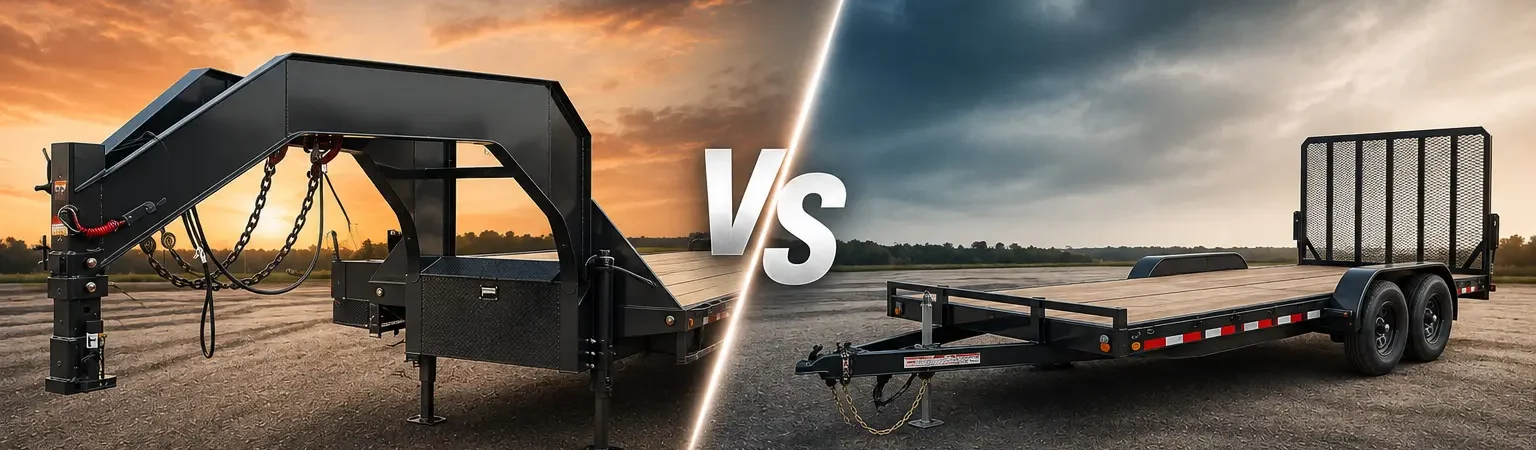
If you have spent any time around trailers, you have probably heard people talk about goosenecks like they are the obvious choice for serious hauling. You have also probably met plenty of people who have towed bumper pull trailers for decades without a single problem. So which one is actually safer? The answer is not as simple as picking a winner, but understanding how each design works makes the tradeoffs a lot clearer.
Both gooseneck and bumper pull trailers are safe when they are properly matched to the right tow vehicle, loaded correctly, and maintained well. That said, the two designs behave differently on the road, and those differences matter more as loads get heavier. This guide breaks down how each works, where the safety differences come from, and how to figure out which fits what you are hauling.
The Basic Difference Between a Gooseneck and a Bumper Pull
The fundamental difference between these trailers comes down to where and how they connect to your tow vehicle.
A bumper pull trailer, sometimes called a tag-along, connects to a hitch mounted at the rear of the tow vehicle, behind the bumper. This is the most common type of trailer and includes everything from small utility trailers to sizable equipment haulers. The connection point sits behind the rear axle of the tow vehicle.
A gooseneck trailer connects to a hitch mounted in the bed of a pickup truck, positioned over or just ahead of the truck’s rear axle. The trailer has an extended arm, the gooseneck, that arches up and over the tailgate and connects to a ball in the truck bed. This places the connection point in a fundamentally different location, and that single difference drives most of the safety and handling distinctions between the two.
Why Connection Point Matters So Much
The location of the hitch point is the heart of the safety comparison, so it is worth understanding exactly why it makes such a difference.
When a bumper pull trailer connects behind the rear axle, the trailer’s tongue weight pushes down on the very back of the tow vehicle, creating a lever effect. The weight sitting behind the rear axle can lift weight off the front axle and act like a pivot point, which is part of what makes bumper pulls more prone to sway, especially as the load gets heavier or speeds increase.
A gooseneck places its weight over or just ahead of the truck’s rear axle instead. This positions the load within the truck’s wheelbase rather than hanging off the back of it. The result is a more stable connection where the trailer’s weight is carried more directly by the truck’s frame and axle rather than levering against it. This is the single biggest reason goosenecks are generally considered more stable, particularly with heavy loads.
Think of it like carrying a heavy backpack. Carried high and centered on your back, the weight feels manageable. Carried in your hands out behind you, the same weight throws you off balance and is much harder to control. Trailer connection points work in a similar way.
Where Goosenecks Have the Safety Edge
For heavier hauling, goosenecks do offer some genuine safety and handling advantages that are worth understanding:
- Greater stability at higher weights
Because the load sits within the truck’s wheelbase, goosenecks resist sway far better than bumper pulls as weight increases. For heavy equipment, livestock, or large loads, this added stability is a meaningful safety benefit.
- Higher weight capacity
Gooseneck hitches and the trucks they pair with are generally rated to handle significantly more weight than bumper pull setups. This means you can haul heavier loads within the equipment’s designed limits rather than pushing a bumper pull setup toward the edge of its capacity.
- Tighter turning
The pivot point in the truck bed allows goosenecks to turn more sharply, which makes maneuvering in tight spaces, backing into position, and navigating farm or job site conditions considerably easier. Easier maneuvering is a safety benefit in its own right, since it reduces the situations where a driver gets into trouble positioning a trailer.
- More predictable handling under load
Heavy bumper pull trailers can develop sway that becomes difficult to control, sometimes dangerously so. Goosenecks are far more forgiving in this regard, which gives the driver more margin for error in challenging conditions.
Where Bumper Pulls Still Make Sense
None of this means bumper pull trailers are unsafe or that goosenecks are always the better choice. For a lot of hauling, a bumper pull is the more practical option, and being practical is part of being safe.
Bumper pull trailers work with a much wider range of vehicles. You do not need a pickup with a bed-mounted hitch, which means SUVs, smaller trucks, and other vehicles can pull them within their rated limits. For anyone who does not own a full-size pickup, a bumper pull may be the only realistic option.
They are also more affordable, both the trailer and the hitch setup. For lighter loads that a bumper pull handles comfortably, spending significantly more on a gooseneck does not buy meaningful additional safety, because the sway and stability concerns goosenecks solve are far less pronounced at lower weights. Bumper pulls are easier to hook up and store as well, since they do not require bed space in your truck and hitching does not involve climbing into the bed. For frequent, lighter hauling, that convenience adds up.
The key point is that for loads well within a bumper pull’s capacity, properly loaded and towed with an appropriate vehicle, a bumper pull is a safe and sensible choice. The safety advantages of a gooseneck become most relevant as loads get heavier and the demands on the setup increase.
The Real Safety Factor: Proper Setup and Loading
Here is something that matters more than the choice between gooseneck and bumper pull: how the trailer is loaded and whether it is properly matched to the tow vehicle. A correctly loaded bumper pull is far safer than an overloaded or poorly balanced gooseneck. Weight distribution is critical regardless of trailer type. Loading too much weight toward the rear of any trailer reduces tongue weight and dramatically increases the risk of sway. A few general guidelines:
- Roughly 60 percent of the load should sit ahead of the trailer’s axle.
- For bumper pulls, tongue weight should generally fall between 10 and 15 percent of the total loaded weight.
- For goosenecks, the recommended range is higher, generally around 15 to 25 percent, because of the different connection geometry.
Matching the trailer to the tow vehicle is equally important. Every tow vehicle has published tow ratings and payload ratings, and exceeding either creates a genuine safety risk no matter which trailer design you choose. A gooseneck does not make an underpowered truck safe to haul beyond its limits, and a bumper pull within its limits is not made dangerous by its design.Proper braking matters too. Trailers over a certain weight require their own braking systems, and a functioning brake controller in the tow vehicle is essential for safe stopping with a loaded trailer. This applies to both designs equally.
The takeaway is that trailer design is one factor in safety, but it is not the whole story. A well-matched, properly loaded, well-maintained setup of either type is far safer than a mismatched or carelessly loaded setup of the other.
So Which Trailer Type Should You Choose?
The right choice comes down to what you are hauling and what you are hauling it with. If you regularly move heavy loads, large equipment, or livestock and have a truck set up for a gooseneck, the added stability and capacity make it the stronger choice for both safety and practicality. The heavier and more demanding your hauling, the more a gooseneck earns its place. If you haul lighter loads, do not own a full-size pickup, or want the flexibility to tow with different vehicles, a properly rated bumper pull is a safe, practical, and cost-effective option, and there is no need to invest in a gooseneck for loads a bumper pull handles comfortably. The best way to decide is to think honestly about the heaviest loads you expect to haul, how often you will haul them, and what tow vehicle you have or plan to use.
Getting the Right Trailer for Your Needs
Choosing between a gooseneck and a bumper pull is not really about which design is universally better. It is about which one fits your hauling needs, your tow vehicle, and how you plan to use it, and both can be safe, reliable options when matched and loaded correctly.
At Penner Trailer Sales, we help customers work through exactly this kind of decision. Rather than pushing you toward the biggest or most expensive option, we take the time to understand what you are hauling, what you are towing with, and how often you will use it, so you end up with a trailer that fits your needs and keeps you safe. If you are weighing a gooseneck against a bumper pull and want help figuring out which makes sense for you, contact Penner Trailer Sales today.
Frequently Asked Questions
Is a gooseneck really more stable than a bumper pull?
Yes, particularly with heavier loads. Because a gooseneck connects over or just ahead of the truck’s rear axle rather than behind it, the trailer’s weight sits within the truck’s wheelbase, which resists sway far better than a bumper pull’s connection behind the axle. This advantage becomes more pronounced as loads get heavier, which is why goosenecks are preferred for serious hauling.
Can a bumper pull trailer be just as safe as a gooseneck?
For loads within its rated capacity, yes. A properly loaded bumper pull matched to an appropriate tow vehicle is a safe choice. The gooseneck’s advantages are most relevant with heavy loads where sway and stability become bigger concerns. For lighter hauling, a bumper pull handles the job safely and is often the more practical option.
Do I need a special truck for a gooseneck trailer?
Yes. A gooseneck requires a pickup with a hitch mounted in the bed, positioned over or ahead of the rear axle. You cannot tow one with an SUV or a vehicle without a truck bed. This is one reason bumper pulls are more common, since they work with a much wider range of tow vehicles.
What is the right tongue weight for each type?
For bumper pull trailers, tongue weight should generally be 10 to 15 percent of the total loaded trailer weight. For goosenecks, the recommended range is higher, generally around 15 to 25 percent, because of the different connection geometry. Proper tongue weight is one of the most important factors in preventing sway, so it is worth getting right regardless of trailer type.
Why do goosenecks turn more sharply than bumper pulls?
The pivot point sits in the truck bed, over the rear axle, rather than behind the vehicle. This allows the trailer to turn at a tighter angle, which makes backing up and maneuvering in tight spaces considerably easier, a practical advantage in farm, job site, and other close-quarters settings.
Is a gooseneck worth the extra cost?
It depends on what you are hauling. For heavy loads, large equipment, or frequent demanding hauling, the added stability, capacity, and maneuverability of a gooseneck are well worth the investment. For lighter loads within a bumper pull’s capacity, the extra cost does not buy meaningful additional safety, so a bumper pull is usually the more sensible choice.