
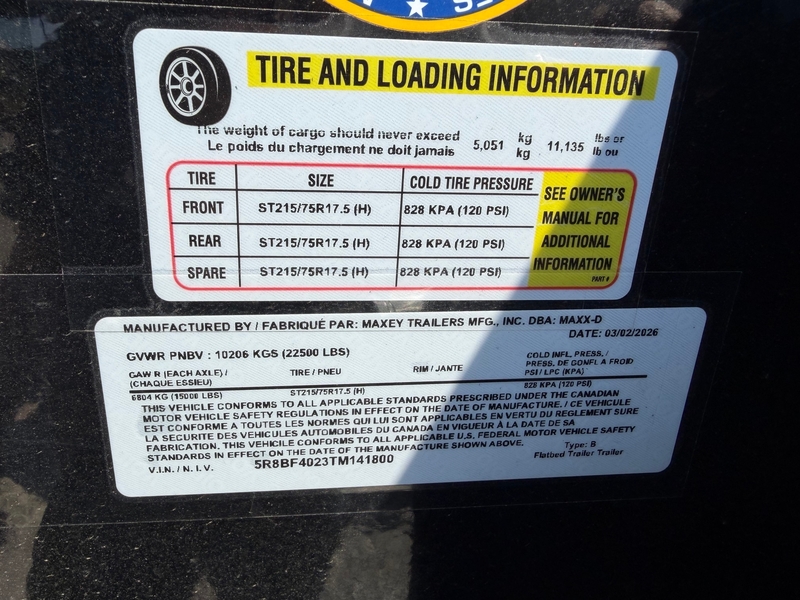
If you have spent any time shopping for a trailer or reading through the specs on one you already own, you have almost certainly come across the acronym GVWR. It shows up on stickers inside the trailer door, in manufacturer documentation, and in just about every conversation worth having about towing capacity. It is one of those terms that gets thrown around constantly but does not always get explained clearly.
Understanding what GVWR actually means, where it comes from, and why it matters in practical terms is not just useful for passing a roadside inspection. It is the foundation of making smart decisions about what you haul, how you load it, and what kind of trailer you actually need for the work you are doing.
GVWR Defined
GVWR stands for Gross Vehicle Weight Rating. It is the maximum allowable weight of a fully loaded trailer as determined by the manufacturer. That number includes everything: the trailer itself, every piece of cargo loaded onto it, any fuel or fluids if applicable, and any equipment that is part of the trailer’s setup.
It does not mean the maximum weight of what you can put on the trailer. It means the maximum weight of the entire loaded unit combined. The GVWR is set by the manufacturer based on the structural design of the trailer, the capacity of the axles, the load rating of the tires, and the strength of the frame and hitch components. It is not an estimate or a suggestion- it is an engineering limit that reflects the point at which the trailer’s components are designed to safely operate.
Where to Find the GVWR on Your Trailer
The GVWR is listed on the trailer’s certification label, which is typically a sticker or metal plate affixed to the front left side of the trailer or inside the tongue area. On most trailers you will also find it stamped on the axle itself and listed in any paperwork that came with the trailer at the time of purchase. If the label on your trailer has worn off or is no longer legible, the manufacturer can usually provide the information using the trailer’s VIN. Do not guess at this number or rely on a rough estimate, as the GVWR truly is too important to approximate!
If you are shopping for a trailer and trying to compare GVWR across different models, the manufacturer’s spec sheet will list it clearly. It is one of the first numbers worth looking at because it tells you immediately whether a given trailer is in the right range for what you plan to haul.
The Difference Between GVWR and Actual Weight
This is where a lot of people get tripped up, so it is worth making sure the distinction is clear. GVWR is the maximum your trailer is rated to weigh when fully loaded. Actual weight is what the trailer weighs with your cargo, equipment, water, and supplies onboard. To stay within the trailer’s limits, your actual weight should never exceed the GVWR.
The difference between the GVWR and the empty weight of the trailer is sometimes called the payload capacity. That is the maximum weight of cargo you can legally and safely load onto the trailer. If your trailer has a GVWR of 10,000 pounds and an empty weight of 3,500 pounds, your payload capacity is 6,500 pounds. Loading more than that pushes the total weight over the GVWR, which means you are exceeding the engineering limits the trailer was built to.
Overloading a trailer is one of the most common and most consequential mistakes people make when hauling. It stresses the frame, the axles, and the tires beyond their designed limits. It affects braking distance and handling in ways that create real safety risks on the road. And it creates legal exposure when you pass through a weigh station or encounter a roadside inspection.
Why GVWR Matters for Towing Legally and Safely
GVWR is not just an internal engineering spec. It has real implications for how your trailer needs to be registered, whether you need a special license to tow it, and how it is treated at weigh stations and by law enforcement.
In most states, trailer registration fees and categories are based on GVWR. A trailer with a higher GVWR falls into a different registration class than a lighter one, which affects what you pay and what documentation is required. If your trailer is registered in the wrong category for its actual GVWR, that is a compliance issue regardless of how much it actually weighs on any given trip.
CDL requirements in many states are also tied to combined weight ratings that include the GVWR of the trailer. If the combination of your tow vehicle’s Gross Vehicle Weight Rating and your trailer’s GVWR crosses certain thresholds, a commercial driver’s license may be required even for private hauling. The specific thresholds vary by state, but the GVWR of the trailer is always part of the calculation.
At weigh stations, commercial vehicles are weighed against their registered GVWR and actual axle weights. Exceeding either creates a violation. For private operators, enforcement is less systematic but roadside inspections do happen, and an overloaded trailer creates both a safety risk and a legal one.
GVWR and Your Tow Vehicle
Understanding your trailer’s GVWR is only half of the equation. The other half is making sure your tow vehicle can actually handle it.
Every tow vehicle has its own published tow rating, which is the maximum trailer weight the vehicle is designed to pull. That number needs to be higher than the loaded weight of your trailer, but loaded weight and GVWR are not always the same thing. If you consistently haul near the maximum, the GVWR and the tow rating need to line up. If your tow vehicle’s tow rating is lower than your trailer’s GVWR, you should not be loading the trailer to its maximum capacity even if the trailer itself can handle it.
Payload capacity on the tow vehicle is a separate number that also comes into play. Payload covers everything in and on the truck including passengers, cargo in the bed, and the tongue weight from the trailer. Tongue weight, the downward force the trailer exerts on the hitch, is typically somewhere between 10 and 15 percent of the total loaded trailer weight. That weight counts against your truck’s payload rating, not just the tow rating, and it is easy to exceed the payload limit without realizing it even when you are within the tow rating.
The practical takeaway is that matching your trailer to your tow vehicle requires looking at both ratings together rather than checking them independently. A trailer with a GVWR that exceeds your vehicle’s tow rating is too much trailer for that vehicle, regardless of how it is loaded on any given day.
How GVWR Affects the Trailer You Should Buy
When you are shopping for a trailer, GVWR is one of the first specs to evaluate because it determines the range of loads the trailer is actually built to handle. Buying a trailer with a GVWR that is too low for your typical loads means you will be overloading it regularly. Buying one with significantly more GVWR than you ever need means you are likely paying for capacity you will never use. The right approach is to think about the heaviest load you realistically expect to haul, add a reasonable buffer above that, and look for trailers whose GVWR comfortably covers that number. The buffer matters because edge cases happen. You might haul something heavier than usual, or your load calculation might be slightly off. A trailer that is rated right at the edge of your typical load gives you no margin for error.
Axle configuration is closely tied to GVWR as well. A single-axle trailer distributes its entire loaded weight through one axle, which places a lower ceiling on how high the GVWR can go while staying within legal axle weight limits. Tandem-axle trailers spread the load across two axles, allowing for higher GVWR ratings while keeping each individual axle within legal limits. For anyone hauling heavy equipment, livestock, or large loads on a regular basis, a tandem-axle trailer is almost always the right choice from both a capacity and a stability standpoint.
Gooseneck trailers, which attach in the bed of a pickup rather than to a standard ball hitch, offer higher GVWR options and better weight distribution for heavier loads. If your work regularly involves hauling large tractors, construction equipment, or multiple pieces of heavy machinery, the combination of a gooseneck trailer and a capable one-ton truck is where the math tends to work out best.
A Number Worth Knowing Before You Load
GVWR is one of those specifications that feels technical until you understand what it is actually telling you, and then it becomes one of the most straightforward and useful numbers associated with your trailer. It tells you exactly how much the loaded trailer can weigh. Everything else, how you load it, what vehicle you pull it with, how it gets registered, and whether you are operating legally on the road, flows from that single number.
If you are not sure what your trailer’s GVWR is, find out before your next haul. And if you are shopping for a new trailer and want help matching the right GVWR and configuration to what you actually need to haul, that is exactly the kind of conversation the team at Penner Trailer Sales is set up to have.
Frequently Asked Questions About GVWR
Is GVWR the same as how much my trailer can carry?
Not exactly. GVWR is the maximum total weight of the trailer fully loaded, which includes the trailer itself plus all cargo. The weight you can actually carry, sometimes called payload capacity, is the GVWR minus the empty weight of the trailer.
What happens if I exceed the GVWR on my trailer?
Exceeding the GVWR puts stress on the trailer’s frame, axles, and tires beyond what they were engineered to handle. It affects braking performance and stability on the road, creates legal exposure at weigh stations and during roadside inspections, and can void your trailer’s warranty. It is one of the more consequential mistakes you can make when hauling, and it is entirely avoidable with a little planning before you load.
Does GVWR affect how I register my trailer?
Yes, in most states trailer registration classes and fees are based on GVWR. A higher GVWR may result in different registration requirements or costs.
Can I tow a trailer whose GVWR is higher than my truck’s tow rating?
No. Your tow vehicle’s published tow rating is the maximum it is designed to pull, and that limit applies regardless of how the trailer is loaded on a given day. If your trailer’s GVWR exceeds your truck’s tow rating, you have a mismatch that needs to be resolved either by using a more capable tow vehicle or by choosing a trailer with a lower GVWR.
Why do some trailers with similar sizes have different GVWRs?
GVWR is based on the trailer’s engineering, including the frame, axles, suspension, and tires. Two trailers that look nearly identical can have very different weight ratings depending on how they were built, which is why it’s important to check the specifications rather than judging by size alone.
Does GVWR affect whether I need a CDL to tow my trailer?
It can. CDL requirements are often based on the combined weight ratings of the truck and trailer, and GVWR is part of that calculation. Requirements vary by state, so check the regulations that apply to your situation.